

Oral Health Educational Materials

WIC helps you, your baby, and your children get the nutritious foods you need to grow and thrive as a family.
Community Water Fluoridation Resources
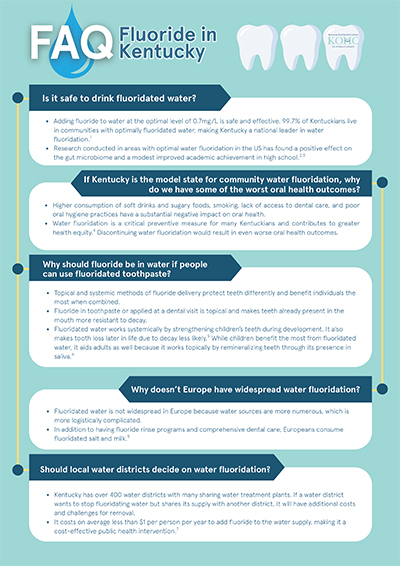
- Adding fluoride to water at the optimal level of 0.7mg/L is safe and effective. 99.7% of Kentuckians live in communities with optimally fluoridated water, making Kentucky a national leader in water fluoridation. (1)
- Research conducted in areas with optimal water fluoridation in the US has found a positive effect on the gut microbiome and a modest improved academic achievement in high school.(2,3)
- Higher consumption of soft drinks and sugary foods, smoking, lack of access to dental care, and poor oral hygiene practices have a substantial negative impact on oral health.
- Water fluoridation is a critical preventive measure for many Kentuckians and contributes to greater health equity.(4) Discontinuing water fluoridation would result in even worse oral health outcomes.
- Topical and systemic methods of fluoride delivery protect teeth differently and benefit individuals the most when combined.
- Fluoride in toothpaste or applied at a dental visit is topical and makes teeth already present in the mouth more resistant to decay.
- Fluoridated water works systemically by strengthening children’s teeth during development. It also makes tooth loss later in life due to decay less likely. While children benefit the most from fluoridated water, it aids adults as well because it works topically by remineralizing teeth through its presence in saliva.(5,6)
- Fluoridated water is not widespread in Europe because water sources are more numerous, which is more logistically complicated.
- In addition to having fluoride rinse programs and comprehensive dental care, Europeans consume fluoridated salt and milk.(5)
- Kentucky has over 400 water districts with many sharing water treatment plants. If a water district wants to stop fluoridating water but shares its supply with another district, it will have additional costs and challenges for removal.
- It costs on average less than $1 per person per year to add fluoride to the water supply, making it a cost-effective public health intervention.(7)
1. Centers for Disease Control and Prevention. (2024, June 6). 2022 Water Fluoridation Statistics. Centers for Disease Control and Prevention. Retrieved Jan 16, 2026, from https://www.cdc.gov/fluoridation/php/statistics/2022-water-fluoridation-statistics.html
2. Yasin, M., Zohoori, F. V., Kumah, E. A., Subramanian, M., Dean, P., & Orr, C. H. (2025). Effect of fluoride on gut microbiota: A systematic review. Nutrition Reviews, 83(7), e1853–e1880. https://doi.org/10.1093/nutrit/nuae202
3.Warren, J. R., Rumore, G., Kim, S., Grodsky, E., Muller, C., Manly, J. J., & Brickman, A. M. (2025). Childhood fluoride exposure and cognition across the life course. Science Advances, 11(47). https://doi.org/10.1126/sciadv.adz0757
4. Burt B. A. (2002). Fluoridation and social equity. Journal of Public Health Dentistry, 62(4), 195–200. https://doi.org/10.1111/j.1752-7325.2002.tb03445.x
5. American Academy of Pediatrics. American Academy of Pediatrics. (n.d.). Fluoride Myths & Facts. I Like My Teeth. Retrieved Jan 16, 2026, from https://ilikemyteeth.org/debate-fluoridation/fluoridemyths-facts/
6. American Dental Association. (2023, June 14). Fluoride: Topical and systemic supplements. American Dental Association. https://www.ada.org/resources/ada-library/oral-health-topics/fluoride-topicaland-systemic-supplements
7. Harrison, R. (2025, January 21). The Facts–and Largely Unfounded Fears–of Fluoride. New York University. https://www.nyu.edu/about/news-publications/news/2025/january/facts-and-fearsfluoride.html?challenge=d06e90d7-4d8f-4b88-9d8c-10b73beb60f1
 View Flyer (PDF)
Kentucky Oral Health Resources




National Oral Health Resources














Oral Health Data and Research
2023 Kentucky Early Learner’s Oral Health Survey
The 2023 Kentucky Early Learner’s Oral Health Survey is the first time in over 20 years that data has been collected on the dental decay rates of pre-school aged children in Kentucky. The survey aimed to evaluate the prevalence of dental decay and treatment needs among Kentucky children ages 2-5 and to identify what populations are most at risk for dental decay. Public health data, such as the information collected from the Early Learner’s Oral Health Survey, plays a critical role in developing policies, programs and services that effectively improve oral health outcomes for people in Kentucky.
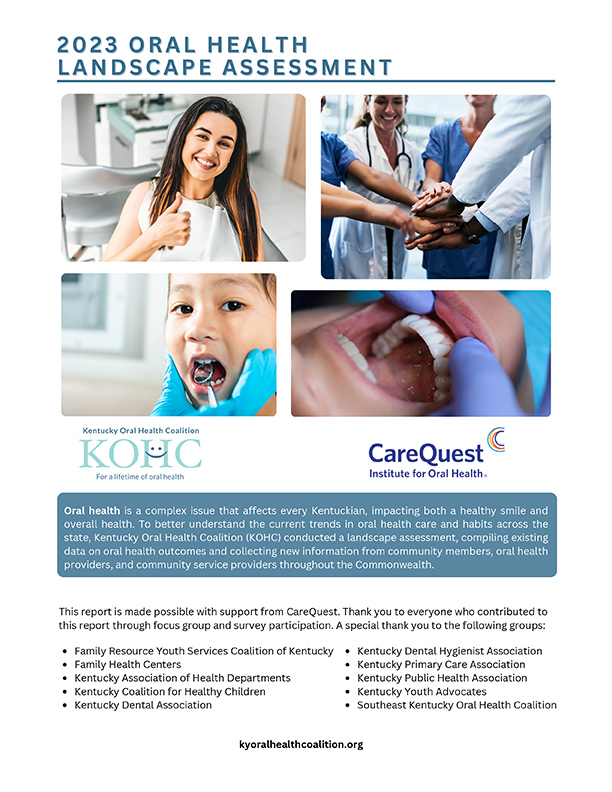
2023 Oral Health Landscape Assessment Report
To better understand the current trends in oral health care and habits across the state, KOHC conducted a landscape assessment throughout 2023, compiling existing data on oral health outcomes and collecting new information from community members, oral health providers, and community service providers throughout the Commonwealth.
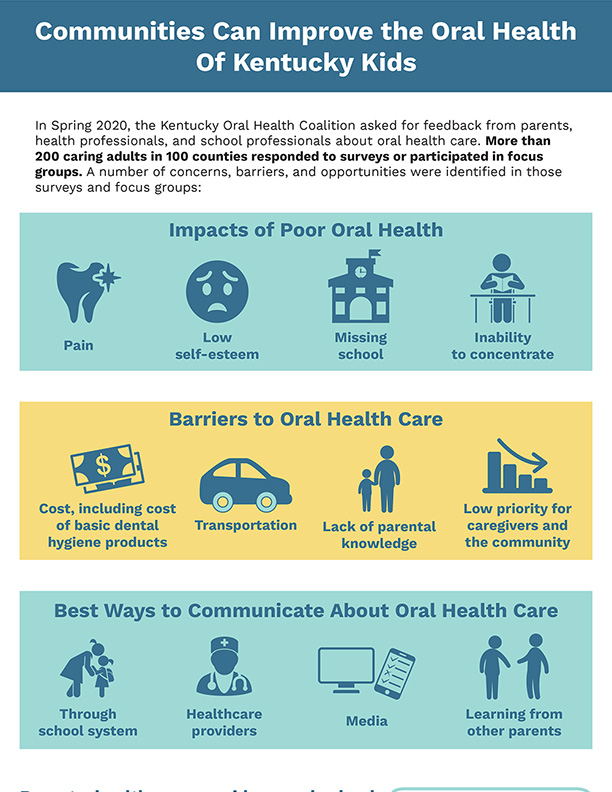
Communities Can Improve the Oral Health of Kentucky Kids
We partnered with the Kentucky Beverage Association to learn more about parents’ beliefs and knowledge about oral health care for their children. KOHC hosted three focus groups in March 2020 with parents from Eastern Kentucky, Western Kentucky, and West Louisville to talk about their children’s oral health care. KOHC also surveyed oral health, primary care, and school professionals to understand the needs for children’s oral health across the state. The focus group and survey results helped us develop six targeted solutions to improve the oral health of all Kentucky kids.

Making Smiles Happen
During the 2015-2016 school year, Delta Dental of Kentucky partnered with Kentucky Youth Advocates, the University of Louisville School of Dentistry, and other key partners to collect data on the oral health status of over 2,000 3rd and 6th grade children. The data provided state and regional pictures of the oral health needs of children in the state. This is the first study of this kind conducted since 2001.
VIEW REPORT | View Regional Data Profiles : Central | Eastern | Louisville | Northern | Western
2014 Roadmap to Oral Health Literacy Planning Report
- Section 1: Oral Health 2014 Oral Health Literacy Planning Grant Summary
- Section 2: Focus Group Findings
- Section 3: Oral Health Literacy Survey Findings
- Section 4: Kentucky Networks and Resources for a Statewide Oral Health Literacy Campaign
Kentucky’s Cavity: Parents Voice Concerns about Children’s Dental Care in their Communities
This report gave parents a chance to talk about their experiences in obtaining dental health services for their children in their communities. Many of the problems, challenges, barriers, and experiences that parents spoke to us about have been documented in other research, some of which we present in this report to support the parents’ observations.
2023 Kentucky Early Learner’s Oral Health Survey
The 2023 Kentucky Early Learner’s Oral Health Survey is the first time in over 20 years that data has been collected on the dental decay rates of pre-school aged children in Kentucky. The survey aimed to evaluate the prevalence of dental decay and treatment needs among Kentucky children ages 2-5 and to identify what populations are most at risk for dental decay. Public health data, such as the information collected from the Early Learner’s Oral Health Survey, plays a critical role in developing policies, programs and services that effectively improve oral health outcomes for people in Kentucky.
2023 Oral Health Landscape Assessment Report
To better understand the current trends in oral health care and habits across the state, KOHC conducted a landscape assessment throughout 2023, compiling existing data on oral health outcomes and collecting new information from community members, oral health providers, and community service providers throughout the Commonwealth.
Making Smiles Happen
During the 2015-2016 school year, Delta Dental of Kentucky partnered with Kentucky Youth Advocates, the University of Louisville School of Dentistry, and other key partners to collect data on the oral health status of over 2,000 3rd and 6th grade children. The data provided state and regional pictures of the oral health needs of children in the state. This is the first study of this kind conducted since 2001.
VIEW REPORT | View Regional Data Profiles : Central | Eastern | Louisville | Northern | Western
Communities Can Improve the Oral Health of Kentucky Kids
We partnered with the Kentucky Beverage Association to learn more about parents’ beliefs and knowledge about oral health care for their children. KOHC hosted three focus groups in March 2020 with parents from Eastern Kentucky, Western Kentucky, and West Louisville to talk about their children’s oral health care. KOHC also surveyed oral health, primary care, and school professionals to understand the needs for children’s oral health across the state. The focus group and survey results helped us develop six targeted solutions to improve the oral health of all Kentucky kids.
2014 Roadmap to Oral Health Literacy Planning Report
- Section 1: Oral Health 2014 Oral Health Literacy Planning Grant Summary
- Section 2: Focus Group Findings
- Section 3: Oral Health Literacy Survey Findings
- Section 4: Kentucky Networks and Resources for a Statewide Oral Health Literacy Campaign
Kentucky’s Cavity: Parents Voice Concerns about Children’s Dental Care in their Communities
This report gave parents a chance to talk about their experiences in obtaining dental health services for their children in their communities. Many of the problems, challenges, barriers, and experiences that parents spoke to us about have been documented in other research, some of which we present in this report to support the parents’ observations.