This year’s KOHC funding partners are focused on oral health education for young children and families in underserved rural areas of Kentucky, where alarming rates of dental poverty in young children are more prevalent. These areas also tend to have the least access to dental care.
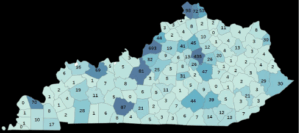
Figure 5. Dentist counts by county. Source: https://medicine.uky.edu/sites/default/files/inline-files/2023%20Dental%20Report%20Final%20Aug%2017%202023.pdf
Dr. Chris Casterline, DMD
Florence Mahoney, CFO
Sterling Health Care, Guest Contributors
Sterling Health Care is a multidisciplinary institution serving the communities of Bath, Bourbon, Clark, Montgomery, Menifee, Nicholas, and Powell Counties. Sterling provides primary care including pediatrics, behavioral health, women’s health, dental and vision services. Also, Sterling provides a wide range of ancillary services to our patients and the community including interpretation services, transportation services, 340B discount medication, and community health workers to assist with social determinants of health issues that individuals may be experiencing. All of the above services are provided regardless of the ability of the individual to pay.
Sterling has two brick-and-mortar dental clinics: one in Montgomery County and one in Nicholas County. To expand our reach and provide dental care to the counties without a stationary dental clinic, the organization recently purchased a new mobile medical/dental clinic. The KOHC funding partnership has been very helpful in the implementation of the mobile unit.
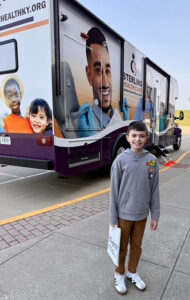
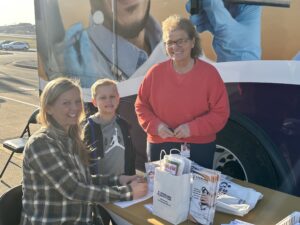
With the KOHC funding the program was able to provide care to four counties, including five elementary schools. Also, we recently participated in after-hours/weekend community events in Bourbon and Montgomery Counties. At these events, kindergarten physical exams and dental screenings were performed, and oral hygiene education/toothbrushes were provided.
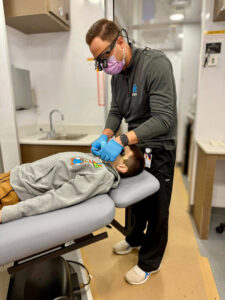
Many of the children in the areas we serve have a lack of resources and are exposed to minimal oral health education. Many of our patients lack reliable transportation. Being able to bring the mobile clinic to them has been instrumental in removing this barrier to care. Also, there is often a misconception by patients that if the parents had “bad teeth,” it simply runs in the family and their child, too, will have bad teeth. Through providing health education at a young age, we aim to flip the script. Our mobile team has vast pediatric experience and is trained in making medical and dental visits a safe space. By instilling this mindset at an early age, kids will transition into adulthood without fear of the physician or dentist, setting them up for a life of great overall health.
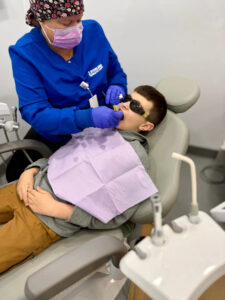
The following are patient stats for the first 3 months of the KOHC funding partnership:
Active tooth decay: 68% of patients
Urgent needs: 13 patients
Treatment plans completed: 27
Treating kids at their school offers unique challenges as well, especially considering parents/guardians are not present. It requires efficient communication between the mobile team, the parents/guardians, and the school staff to ensure all consents are completed and any post-op conversations are documented. Other challenges are:
- Learning how to use the equipment
- Driving the unit and ensuring the equipment is stable during transit
- Installing and utilizing internet in rural areas
Usage of portable radiograph unit We have already identified a high rate of urgent needs, and a good number of these patients have started, or even completed, their treatment plan. By preventing ailments and treating already existing problems, we feel our mobile clinic can be a staple in improving the health of the region.