On Friday, March 29th KOHC members and oral health advocates met virtually for the 2024 Spring Quarterly Meeting. More than 60 participants convened for updates on KOHC legislative priorities, updates on Coalition projects and initiatives, and for a panel discussion about ways to improve access to oral healthcare in Kentucky.
Alicia Whatley, Policy and Advocacy Director for Kentucky Youth Advocates and KOHC’s project lead, began the meeting with updates on 2024 KOHC policy priorities:
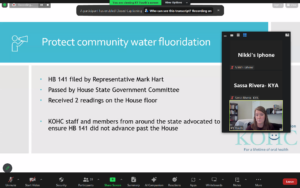 Protect community water fluoridation – House Bill 141, which would allow localities to opt out of community water fluoridation, received two readings in the House and had early momentum. KOHC sent an action alert to advocates along with letters to House and committee members, and KOHC members testified to help slow its progress. Members discussed ways to defeat future iterations of the bill and protect community water fluoridation going forward.
Increase Medicaid reimbursement rates for dental providers – The final version of House Bill 6 removed language that would have specified rate increases for Medicaid dental reimbursements, but we are still optimistic about a path forward for increasing Medicaid dental reimbursement rates. More advocacy work will be needed – stay tuned for updates and action alerts.
Protect current oral health services covered in the Medicaid program – With appreciation to our members who advocated for keeping expanded adult Medicaid dental benefits (and despite last year’s turmoil of emergency regulations and Senate Bill 65 which nullified them), the ordinary regulations which were later put in place to provide these expanded adult Medicaid dental benefits are still in effect.
Reduce youth initiation of tobacco and nicotine products – House Bill 11 fell short of KOHC’s goals to deter retailers from selling to those who are underage and did not provide any increases in funding for prevention and cessation efforts. However there are a few provisions for enforcement of Kentucky’s tobacco-21 law that KOHC will try to build on in the future.
Coalition Updates
Alicia then shared Coalition updates, including the upcoming rollout of KOHC patient education resources which will be shared on our website later this year.
 Panel Discussion and Q&A: Improving Access to Oral Healthcare in Kentucky
Dr. Shannon Moody, Chief Policy & Strategy Officer for Kentucky Youth Advocates, moderated the discussion about improving access to care in Kentucky among panelists:
- Laura Brannon, Project Manager, Dental Therapy, Community Catalyst
- Whitney L. Deitz, DMD, Aspen Dental
- Heather Luebben, ADT, Apple Tree Dental
- Stephen W. Robertson, DMD, Executive Director, Kentucky Dental Association
- Julie Smith, RDH, Director of Dental Services for Cumberland Family Medical Center, Inc.
A robust discussion among our panelists – with Q & A engagement from KOHC members – brought up some ideas for expanding access to care and possible ways that KOHC might move forward with them, including:
Address oral health literacy and systemic barriers to access
 Julie Smith said that getting consent forms from parents was one of the biggest struggles in her mobile dental outreach program. Changing mindsets so that people understand how oral health is connected to overall health is important, as well as meeting people where they are. She recommended increasing oral health literacy beginning in schools as a solution.
Dr. Deitz recommended sending multiple consent forms from the beginning and throughout the school year since vulnerable populations have less bandwidth to keep up with filling out forms.
Laura Brannon acknowledged that patients feel like they are stuck in a system that doesn’t care about them. Emily Beauregard of Kentucky Voices for Health added that they are working on improving access to non-emergency transportation since this is a barrier.
Better utilization of the PHRDH role and making it possible for them to work out of FQHCs
Members weighed in on the possibility of better utilizing those working in the PHRDH role to work in federally qualified health centers.
Dental career pathway programs
Participants and Dr. Robertson noted that Central High School in Louisville, Lawrence County High School, and Paris City Schools in Paris, Kentucky offer programs to guide high school students into dental careers.
Dental therapy
 Laura Brannon emphasized that the conversation about dental therapy needs to be framed as “yes, and….” With oral health being inaccessible and unaffordable all over the country, it is one of the leading drivers of medical debt and contributes to the cycle of poverty. Therefore we need an “all hands on deck” approach, with dental therapy included.
Dr. Robertson countered that Kentucky has “some of the most liberal auxiliary laws in the country.” He noted that our hygienists and assistants can already do almost anything other than prep a crown or a tooth or do extractions, and he is reticent to say that dental therapy is needed when we still have several untapped ways to utilize what we have. He emphasized that most dental offices are small businesses with no corporate umbrella, and they cannot afford to raise their costs. His suggestions included more work that mid-level hygienists could do, more hygienist training programs, rural placement scholarships for hygienists, high school pathway programs, more use of community health workers in dental offices, and increased Medicaid reimbursements.
Dr. Deitz, who supervises teledentistry visits for the Floss and Gloss program in Western Kentucky talked about the challenges of working with vulnerable populations. She said that even with the large volume of interventions and prevention work they do, the status of kids’ teeth is tremendously worse from one year to the next because not enough treatment is available. It’s not unusual that they are edentulating a 13-year-old and a 15-year-old this month due to gross dental neglect, which impairs their health, speech, confidence, and opportunities. Other KOHC members and advocates on the call from eastern Kentucky and from Louisville echoed these concerns about edentulating children due to lack of access to care.
Dr. Deitz’s suggestions for improving access to care included offering flex-cards for Medicaid recipients instead of billing, expanding what the team can do to include SDF and sealants, and to eventually include dental therapists as part of the team.
Laura informed us that dental therapists work in 14 states under the supervision of a dentist and are accredited by the same entity as other dental professionals. She said there is a shortage of dental hygienists largely because they are leaving the workforce due to feeling a lack of respect and lack of opportunities for advancement. She recommended that a team-based approach with mutual respect, growth opportunities, and providers being a part of the community increases community trust and helps to prevent no-shows. She said that comprehensive care is available to more people now due to the cost-effectiveness of dental therapy and that hiring dental therapists can make small businesses more profitable. She also said that dental therapists are working in rural areas and doing a lot of mobile care.
Heather Luebben said that dental therapists work about 40% in rural areas and about 60% in metro areas, which aligns with how the general population is dispersed. Surveys may only list where their headquarters are instead of where all they are practicing. She agreed that multiple solutions are needed to tackle access to care issues. She said she sees horrific dental disease every day even though her state has had dental therapists since 2009, has been using SDF with good reimbursement for 10 years, uses collaborative practice dental hygienists, and offers clinical access dental payment programs. She said that recruiting public health-minded clinicians is very important regardless of which program they are training for.
Education about how to appropriately bill Community Health Worker dental visits
Dr. Robertson noted that dental offices can bill Medicaid for community health workers (CHWs) since June 2023, but so far not a single claim has been filed for it. He said there is a need to educate dental office staff on how it can work. Leah Smothers of the Floss and Gloss Program said that they haven’t been able to bill for their CHW because the services haven’t been added to the preventative fee schedule. Dr. Jerry Caudill of Avesis advised that the billing code is 9994, and that it covers work that addresses barriers to social determinants of health. Information about how to utilize community health workers in dental offices was shared at the 2023 KOHC Annual Meeting.
Increased scope for dental hygienists
Dr. Robertson suggested that it may be helpful to train and allow dental hygienists to perform periodontal work such as super-gingival scaling. Heather Luebben agreed that expanding the scope for dental hygienists, along with telehealth, can be part of the solution to increasing access to care.
More collaboration among private practice dentists and school-based dental outreach centers
Several participants on the call noted that some patients have had difficulty being accepted back at their regular private practice dentist after receiving care from outreach programs.
Dr. Robertson addressed the concern among some dentists that mobile providers who are only doing screening or prophylaxis (prophies) may be taking business away from private practice dentistry and said that he advises them that the referrals may bring in new business.
Julie Smith acknowledged that the history of mobile providers has been mixed, and that they have since been overcoming the image problems coming from out-of-state mobile providers that may not have cared about or known communities. Now regulations have improved, and most mobile providers are based in Kentucky.
Several participants noted that there is competition for the prophy billing code which can only be used once per patient every six months. Dr. Laura Hancock Jones recommended that multiple prophies would be beneficial for children’s oral health. Suggestions included using a Limited Exam Code, making the prophy code billable per provider, and an educational campaign regarding mobile dentistry.
Teledentistry
Several of our panelists and participants use and recommend teledentistry, often in collaboration with other solutions such as school based dental health programs. Dr. Deitz advised that donating telehealth hours offers not only increased access to care but also a good tax break.
Next Steps for KOHC
Our panelists and participants had a great discussion about possible ways to improve access to oral healthcare in Kentucky. The meeting video is available here, and slides can be accessed here.
We are very grateful for the time and expertise shared by our panelists and to everyone who joined and engaged. We hope that members and advocates will join us for our next quarterly meeting in June where we will gather more information about what priorities KOHC should focus on moving forward.
Thank you to CareQuest for support of our work. Information about sponsoring a KOHC meeting can be found here.